

How to Set a Thanksgiving Table That Looks Nothing Like Pinterest
The Thanksgiving table has a visual culture so thoroughly established that it is possible to predict, with reasonable accuracy, what the table at any given gathering will look like before you arrive: the orange and rust color palette, the burlap runner, the mini pumpkins placed at intervals, the cluster of pillar candles in the center, the name cards written in a calligraphy font that took four hours to perfect. All of it assembled with genuine effort and real love, and all of it looking, somehow, less like an expression of the specific family around it than like a mood board made real.
The Thanksgiving table that actually resonates — that people remember, that feels right for the particular place and the particular people in it — doesn't come from a template. It comes from looking at what you actually own, what the garden or the farmers market or the woods near your house is offering in the third week of November, and what this table has always been, and building from there rather than from a set of objects chosen to match an idea of what the table should look like.
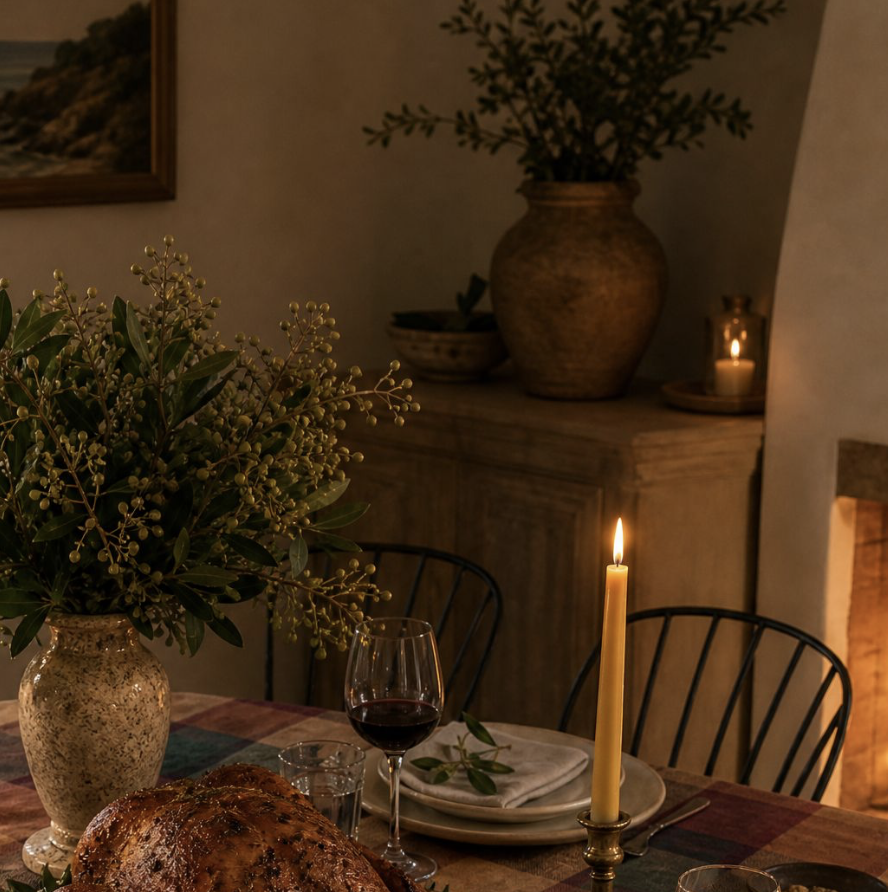
The most beautiful Thanksgiving tables we've encountered have almost always had a few things in common, none of which involve burlap or matching chargers. They've had real light — candles in multiples, placed low enough that people can see each other across the table, burning from before the guests arrive so the room is already warm with it when the first person walks in. They've had something from outside — branches, foliage, herbs, fruit — arranged without fussiness in whatever vessel seemed right. They've had good linen, not necessarily matching, sometimes a mix of tablecloth and runner, napkins that have been used enough times to be soft and slightly irregular. They've felt inhabited rather than installed.
The centerpiece question is where most people exhaust themselves, and it is, of the decisions to be made, among the least consequential. Guests look at the centerpiece for the first five minutes and then look at each other for the remaining four hours. What matters about the center of the table is that it doesn't obstruct conversation — nothing so tall that people are talking around it — and that it contributes something atmospheric rather than demanding attention. A long, low arrangement of foliage and a few last garden roses, or persimmons and walnuts in a shallow wooden bowl, or a scatter of pillar candles in different heights with a few branches of berries laid between them — all of these do the work without performing it.
The place setting is worth the attention that the centerpiece steals. The specific alignment of the fork, the way the napkin is folded or simply laid, the choice of glassware — these are what each individual person at the table actually sees and touches and uses for hours, and they accumulate into the experience of being at that table in a way that the centerpiece doesn't. A napkin tied simply with a piece of twine and a sprig of rosemary, placed on a well-chosen plate, is more memorable than an elaborate centerpiece because it is personal in scale. It was made for the person sitting there.
The aspiration, if there is one for the Thanksgiving table, is not a table that looks like anywhere else. It's a table that looks like here — like this house, this family, this late November, these particular people gathered for this particular meal. That table cannot be found on Pinterest, which is precisely what makes it worth setting.
