

November Field Notes — The Beauty of the Bare Garden
November is the month when the garden makes its most counterintuitive demand: that you find it beautiful. Not in spite of what it's lost but because of it, because the stripping-back that autumn performs reveals a structure and a character that the lushness of summer conceals. The bones of the garden, as experienced plantspeople always say. November shows you what they meant.
The bones are the permanent and semi-permanent elements — the hedges and the trees, the arching stems of winter-fruiting shrubs, the silhouette of an ornamental grass against a pale sky, the path materials and the walls and the way the garden is divided and ordered. A garden with beautiful bones looks extraordinary in November in the way that a garden without them never quite does, regardless of how spectacular its June border may be. November is, in this sense, the honest month: it shows you what the garden actually is when the flowers aren't carrying it.
In the Northern Hemisphere, November is the time to look at the garden with winter eyes and make notes about what's missing. Where is the garden uninteresting right now? Where is there no structure, no bark color, no berry, no seed head, nothing that catches the low light or holds the eye? These are the gaps to address, and addressing them means planting for winter interest rather than summer flower — a different category entirely, and a less crowded one.
The plants that earn their place specifically in November and the months that follow are worth knowing well. Cornus alba and Cornus sanguinea — the ornamental dogwoods — are grown almost entirely for the vivid red, orange, or yellow stems that glow against grey November skies; cut them hard in early spring and they produce the most brilliant young stems the following winter. Betula (birch) trees offer peeling white or copper-colored bark that is most visible once the leaves have fallen. Hamamelis (witch hazel) begins to open its spidery, frost-hardy flowers in November and continues through February — the scent, faintly sweet and spicy, is one of the winter garden's true gifts. Sarcococca (sweet box), a small evergreen shrub with tiny white flowers that appear in November and December, produces a fragrance disproportionate to its size, sweet and vanilla-like, that drifts on cold air in a way that feels almost impossible.
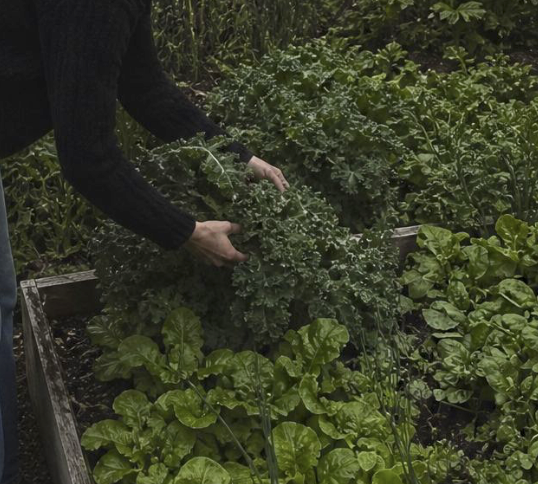
For the kitchen garden in November: in Zones 6 through 9, hardy greens — kale, chard, spinach, arugula, mâche — continue producing through the month and often into December under a layer of horticultural fleece or a simple cloche. These are the greens of genuine cold-weather flavor — kale and chard that have been touched by frost have a sweetness that their summer counterparts don't, because the plant converts starches to sugars as a form of antifreeze. November kale is better than July kale. This is not negotiable.
Root vegetables still in the ground in November — parsnips, carrots, celeriac, leeks — are similarly at their best after the first frosts, which do the same starch-to-sugar conversion in the root that they do in the leaf. Leave them in the ground until you need them if your soil doesn't freeze solid; the earth is the best storage available and the flavor improves as the weeks pass.
The other November garden practice worth establishing is the records habit: spending twenty minutes at the end of the season writing down what grew well, what failed, what surprised you, what you wish you'd planted more of and what you'd leave out next time. These notes, kept in a simple notebook or even a notes app with dated entries, are the accumulated wisdom of the gardener's own garden specifically — not generalizable to anyone else's garden, and more useful than any book or website because they're yours. The garden forgets everything between seasons. You have to remember for it.
