

How to Deadhead, Stake, and Keep Summer Blooms Going
The difference between a garden that peaks in June and then slowly declines through summer and one that continues producing abundantly until frost is, in large part, a matter of three practices done consistently: deadheading spent flowers, staking plants before they fall, and making smart decisions about what gets cut and when. None of these is complicated. Together, they are the ongoing maintenance work of the productive cutting garden — not glamorous, but deeply satisfying, and responsible for the difference between a few weeks of flowers and an entire season of them.
Deadheading — removing spent flowers before they form seed — is based on a fundamental principle of plant biology: a flowering plant's biological imperative is reproduction, and once it successfully produces seed, it has accomplished its purpose and slows or stops flower production. By removing spent blooms before seed sets, you interrupt this cycle and signal the plant to continue making flowers. The effect is most dramatic in annuals (plants that complete their entire life cycle in one season), which will flower continuously all summer with consistent deadheading, but it is also meaningful in many perennials.
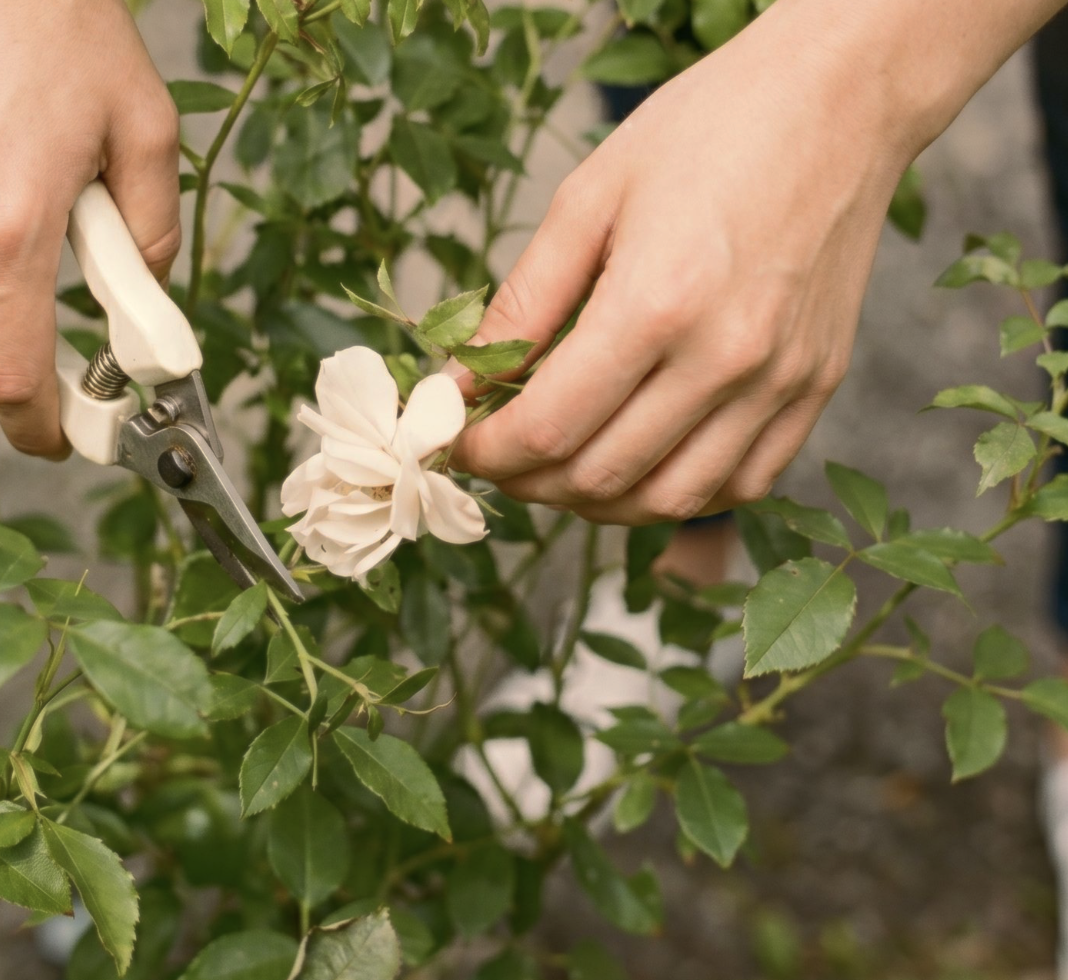
The mechanics of deadheading depend on the plant. For roses, cut the spent bloom back to the first set of five leaflets, making a cut at a 45-degree angle just above an outward-facing leaf node. This directs new growth outward and maintains the open vase shape of the plant. For dahlias, cut the stem back to the next visible bud or lateral shoot — there is almost always one waiting just below the spent bloom. For zinnias, snap or cut the stem back far enough that you're cutting above a leaf node where new laterals will form; cutting just under the dead head leaves a short, leafless stub that doesn't produce new growth. For lavender, shear lightly with garden scissors after the first flush of bloom — removing the spent spikes but not cutting into old wood — to encourage a second bloom later in summer.
Some plants should not be deadheaded at all: those grown primarily for their decorative seed heads (nigella, lunaria, alliums, teasel) are more beautiful in their seed form than in bloom and should be left to develop fully. Others — echinacea, rudbeckia, grasses — provide valuable food for birds through autumn and winter if left to seed, and the decision about whether to deadhead them is as much ecological as aesthetic.
Staking is a task that is almost always done too late, which is to say after the plant has already fallen over in a storm or under its own weight and been damaged. The time to stake is before the plant needs it — when it is upright, growing, and clearly heading toward a height at which it will become unstable. Knowing which plants will need staking is a matter of familiarity with species and cultivars: dahlias above 60cm / 24 inches will almost always need support. Tall bearded iris benefit from it. Peonies with large double flowers are notorious for collapsing after rain. Delphiniums are architectural but wind-vulnerable. Learn which plants in your garden are stakers and install support early.
The support itself should be as invisible as possible in the finished garden — not a cage that surrounds the plant and is visible from fifteen feet away all summer, but a support structure that the plant grows into and through. Grow-through supports (wire grids on legs that the plant rises through) are elegant for peonies and grasses. Single bamboo canes with soft twine in a figure-eight loop work well for tall single-stemmed plants like delphiniums. For dahlias, a sturdy central stake with the main stem loosely tied at intervals, and short lateral stakes for horizontal branches, is the most secure approach. The key word in all of this is loose: ties should secure the stem against the support without constricting it, because constricted stems lose water uptake capacity and become vulnerable to disease.
For the cutting garden specifically, the act of cutting flowers for the house is itself the best form of deadheading and the highest form of encouragement. Cut deep — not just the head, but a long stem down into the plant, cutting just above a leaf node or lateral bud. Cutting deeply stimulates the most vigorous new growth. Cutting shallowly, leaving long bare stems on the plant, is common but counterproductive. The more you cut, the more the garden gives.
