

A Guide to Seasonal Tablescaping — Spring Edition
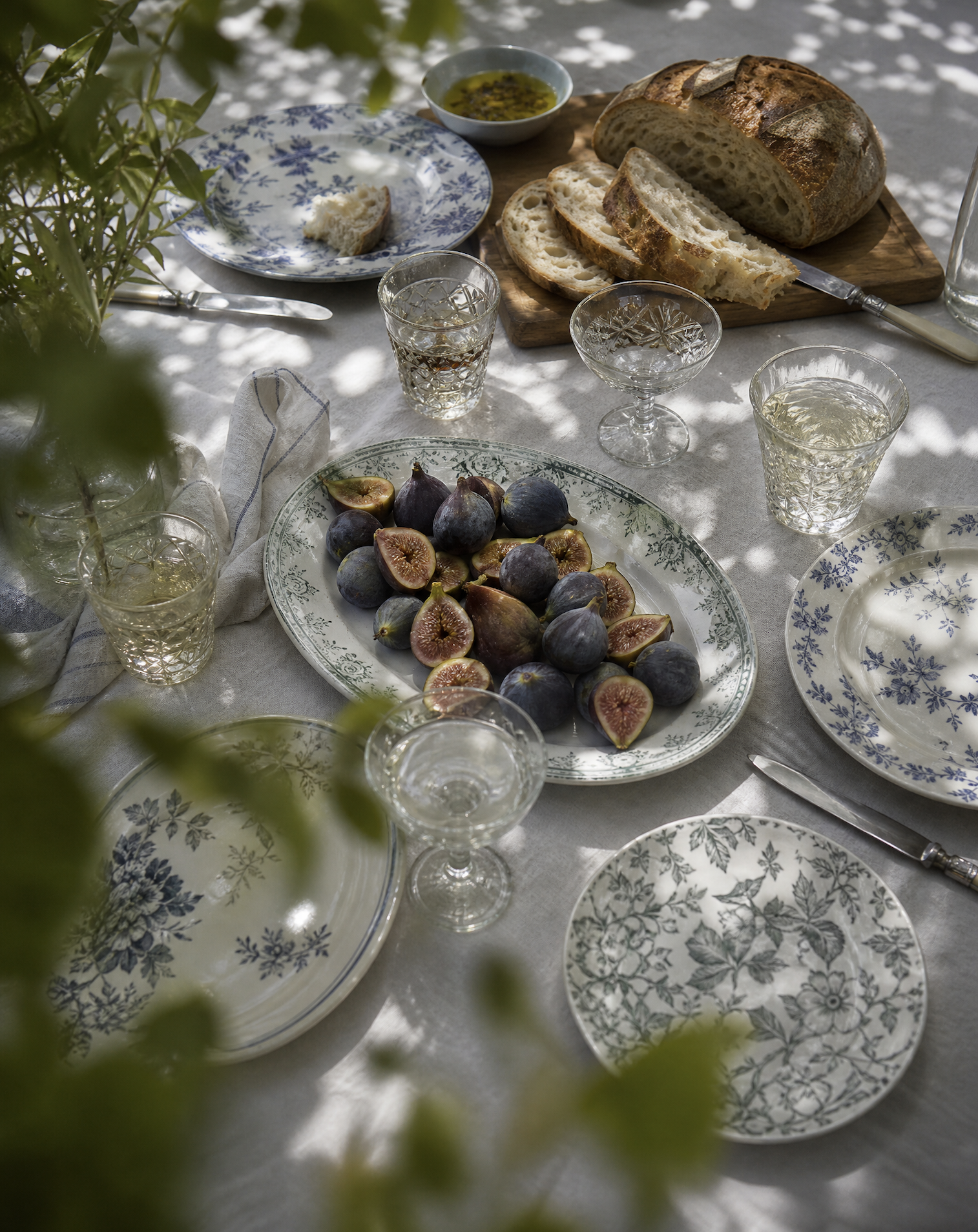
The table is one of the most expressive surfaces in a home, and also one of the most overlooked outside of holidays and special occasions. There is a widespread belief that a beautiful table requires either a special event to justify it or a budget for floristry and props that most people don't have. Neither is true. What a beautiful table actually requires is attention to a handful of structural principles and a willingness to work with what the season is offering — which in spring is, frankly, quite a lot.
Approach the practice of composing a table the way you'd compose any other arrangement: with attention to height variation, texture contrast, scale, and negative space. The same design principles that govern a bookshelf or a mantel govern a table setting. Understanding them means you can create something genuinely beautiful without following a formula or buying anything new.
The first principle is height variation. A flat table — all plates and glasses and nothing rising above — reads as incomplete, regardless of how lovely the individual elements are. You need at least one element that creates vertical interest: a candle (or several), a small vase of flowers or branches, a bowl of fruit stacked high enough to matter. In spring, a few branches of blossoming fruit tree cut from the garden and placed in a tall vessel are extraordinary — they're free, they smell beautiful, and nothing reads as more deliberately seasonal. If you don't have blossoming branches, a loose bunch of tulips in a simple ceramic vase costs almost nothing at a grocery store and transforms a table completely.
The second principle is texture contrast. Hard and soft, matte and shining, rough and smooth. The visual interest of a well-set table comes from the relationship between textures: linen napkins against the smooth surface of a ceramic plate, the glint of a glass against a wooden board, a rough-surfaced pottery bowl next to a polished candlestick. When everything on a table is the same surface quality — all smooth, all matte, all shining — it reads as flat regardless of how expensive or beautiful the individual pieces are. Mix deliberately.
The third principle — and the most often violated — is restraint. A beautiful table has negative space. Not every inch needs to be occupied. The eye needs places to rest. This is particularly true in spring, when the instinct is to load the table with all the flowers and greenery that have been absent for months. Resist. Three stems in a simple vessel beat twelve stems in a complicated arrangement almost every time. A single candle in the center of the table beats a cluster of five mismatched ones. Edit until it feels like there might be one thing too few, and then stop.
For spring specifically: work with what April is genuinely offering. Forced bulbs — hyacinths, narcissus, muscari — are still available and spectacular as living centerpieces, planted in small pots rather than cut. A bowl of eggs in various shades (the blue-green of Araucana eggs, the deep brown of a Marans, the pale cream of a Leghorn) is one of the most quietly beautiful table arrangements possible in April, and costs nothing beyond the eggs themselves. Herbs in small pots — rosemary, thyme, chives beginning to flower — are functional and beautiful simultaneously.
The napkin, often the most underconsidered element of a table setting, is worth real attention. A linen napkin — not the stiff, formal kind, but the washed, softened, slightly rumpled kind — does more work than almost any other element in signaling care and ease simultaneously. Learn two or three simple folds (a loose roll, a flat fold with the short edge showing, a simple envelope) and rotate between them. The napkin should look like it was folded by someone who knows what they're doing and didn't spend much time on it.
