

Decorating for the Holidays with Botanicals — No Plastic, Nothing from a Box
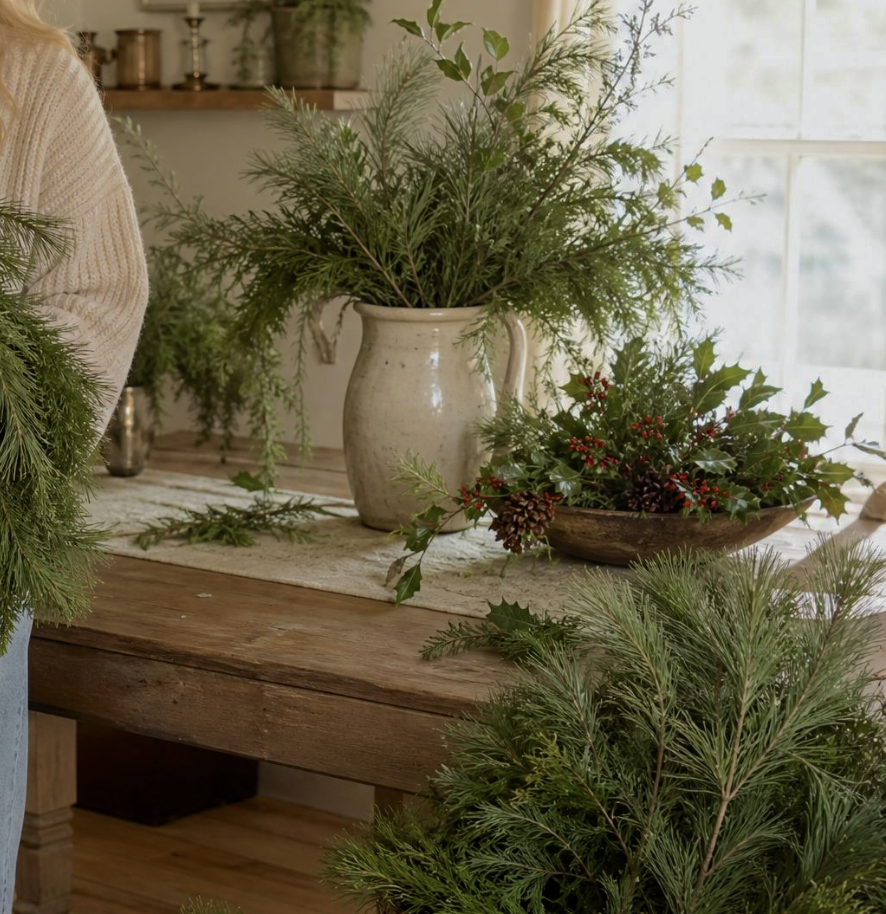
There is a category of holiday decorating that is entirely free, or very nearly so, and that is also — by a significant margin — the most beautiful kind available. It does not come from a box or a bin at a craft store. It does not involve anything that needs to be untangled, tested, or inflated. It comes from the garden, the woods, the farmers market, and the kitchen, and it smells like winter itself rather than like whatever synthetic approximation of pine a paraffin candle offers.
The botanical holiday home starts with evergreen, which has been the defining element of winter decoration in the Northern Hemisphere since long before Christmas existed as a holiday — the mid-winter festivals of pre-Christian Europe were built in significant part around the power of living green in the darkest weeks of the year, and that impulse still operates in us whether we know its history or not. What we reach for in December, unconsciously, is green and living, because everything else has gone brown and dormant and the living green is the proof that something endures.
Fir and spruce boughs, cut from the lower branches of existing trees rather than bought pre-cut, are the workhorses of botanical decoration. They can be laid along a mantel, wound along a stair railing, tucked into a wreath form, arranged in a vase with water, or laid flat as a table runner under candles and objects. They last for weeks in the cold, longer if kept moist, and their scent — when the needles are warmed by candlelight — is one of the genuinely irreplaceable scents of the season. Pine, juniper, and cedar all offer variations on the same theme, each slightly different in texture, density, and fragrance.
Bay laurel (Laurus nobilis) is one of the most underused botanical holiday materials and one of the most beautiful. The large, deep green, slightly glossy leaves dry well and hold their color through the season; they can be used fresh or dried, wired into wreaths and garlands, tucked into evergreen arrangements, or laid flat in large overlapping sprays. A bay wreath — made simply by wiring overlapping sprays of fresh bay onto a metal or willow ring — is more elegant than most things sold at twice the price, and it can be taken apart and used for cooking in January.
Dried citrus is easy to make, beautiful, and fragrant. Slice oranges, blood oranges, lemons, or clementines into rounds about half a centimeter thick and dry them in an oven set to its lowest temperature — usually 170°F / 75°C — for three to four hours, turning once, until completely dried and slightly translucent at the edges. Threaded on string or wire, they become garlands. Laid in bowls with cinnamon sticks and star anise, they are a centerpiece and a room scent simultaneously. Hung on the tree or tucked into an evergreen wreath, they add color and warmth without anything synthetic.
Moss, gathered from the garden or a damp shaded bank, can be used to cover the base of potted plants, to line a wreath form before adding other materials, or simply placed in a shallow bowl as a base for candles, stones, or small botanical objects arranged on top. Its green is one of the most vivid greens available in December, and it brings something ancient and specific to any arrangement.
The holiday home decorated with real botanical materials smells correct — like fir and bay and orange peel and beeswax — in a way that no purchased decoration can replicate. It also changes through the season: the fresh arrangements dry gradually, the citrus deepens in color, the fir needles drop eventually and leave a dry, resinous carpet on the mantel. None of this is a failure. It is the material participating in time, which is all winter decoration has ever been asked to do.
